

Call it the rare earth magnet comeback.
Walking the floor at CES this week, my mind traveled to rare earth magnets. These magic metal products put so many advanced tech products into motion – from humanoid robots to drones to electric cars. Performance magnets turn electricity into motion at the wheel of electric vehicles and they transform motion into electricity inside wind turbines.
Then my mind jumped to the reality that China has a chokehold on rare earth metals, accounting for 90% of global neodymium magnet production. I wrote about this crisis last June: America cannot build a single guided missile without permission from Beijing. That’s not hyperbole. It’s the stark reality of our dependence on Chinese rare earth magnets.
When China retaliated against U.S. tariffs in April by announcing export restrictions on seven rare earth elements, magnet exports halved within weeks. Ford shut down Explorer production. German automakers warned of lines coming to a standstill.
Then came October. China tightened the screws further, announcing that any foreign company wanting to export magnets containing more than 0.1% of Chinese-sourced rare earths would need a license.
America and its Western allies cannot afford to be held hostage.
New American Player
A few points of light are beginning to shine through. Earlier this week, I noticed that a company called Evolution Metals & Technologies Corp. began trading on Nasdaq under the ticker symbol EMAT.
Their ambition is to become a U.S.-based rare earth magnet manufacturing champion and break China’s dominance in high-performance magnets.
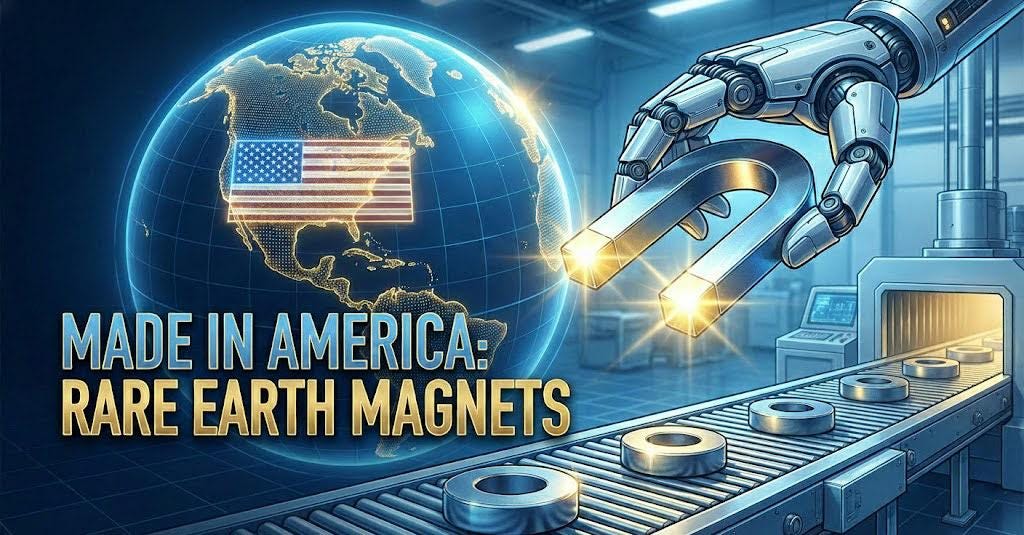
What caught my attention was not simply their ambitious vision. It’s that, according to the company’s materials, EMAT has been producing and selling rare earth magnets for 18 years, with existing manufacturing operations in South Korea and customer relationships that include major global OEM brands.
EMAT says it plans to replicate and scale those proven magnet plants in the United States over the next couple of years, targeting 55,000 tons per year of high-performance magnet capacity.
How Did We Get Here?
In 1985, the U.S. controlled 60% of rare earth production. We had the mines, the processing, and the magnet manufacturing. Then we gave it all away.
As I wrote previously, the most devastating blow wasn’t Chinese industrial espionage; it was American corporate short-sightedness. In 1995, General Motors sold Magnaquench, which supplied 85% of rare earth magnets for American guided missiles, for $56 million – the cost of a single F-35. The buyers? Chinese state-linked companies. By 2004, the last U.S. facility was shuttered and the machine tools shipped to China.
Today, China controls about 90% of rare earth metal making and magnet manufacturing and 99% of heavy rare earth supply (the dysprosium and terbium needed for high-performance magnets).
U.S. Wakes Up
Since 2020, The U.S. Department of Defense has committed $439 million since 2020 to rebuild domestic supply chains. MP Materials reopened Mountain Pass and got a $400 million DoD investment last July. But even with all that money, they’re targeting just 1,000 tonnes annually. And they can only produce low-grade magnets because they do not have a domestic source of heavy rare earths.
EM&T’s edge is feedstock. Their primary source? E-scrap. Instead of mining rare earth ore, EM&T recycles existing magnets from end-of-life electronics. They get paid a processing fee to take the e-scrap, recover the rare earths and turn them into new magnets.
Bottom Line
I’ve been watching China outmaneuver the West in supply chains for two decades. The pattern is always the same: we recognize the threat years after China has locked up the strategic advantage.
Can EM&T deliver? They appear to have the track record, the engineering team, and a differentiated feedstock strategy. Scaling from 660 tons per year in South Korea to 55,000 tons in the U.S. is a formidable undertaking, but they are the only company outside China with more than a decade of commercial magnet production experience.
We cannot keep outsourcing critical supply chains to a country that has explicitly told us it’s ready and willing to cut us off.
Look for more American magnet “points of light” like EM&T and MP Materials to emerge in the coming years – the sooner the better.
Two key comments here. First - you are right, Mike, we 'Gave it away.' Or rather, we sold it. Second - China's actions on REs was a reasonable response to our own blocking actions on them. We picked the fight.
We must develop critical tech. and fund protective industries. But to blame/shame China for this failure is misplaced.
Did you watch the testimony by Charles Parton to the House Special Committee on the CCP? He says Cellular Modules (CIMs or IoTs) are the next "Rare Earths" supply chain issue. China controls 70 percent of world supply currently and is pushing for a monopoly.